

Article by Calvin Rarie. Double Turn section by Peter Atkinson.
The time has come at last, AOS 4th edition is nigh upon us! What that means is new players to the game, and old players (and TOs) desperately trying to figure out what the fuck is going on.
With the edition change, we at Plastic Craic figured it would be a good time to try to create a helpful article for those of you on the 40K side to make the transition to Age of Sigmar a bit easier. We also wanted to give you existing AOS players out there some tools and useful tips on how to describe the differences between the games as well. These are complex games we are talking about here, so the following information is not going to be granularly precise–this is simply to help get an understanding of the game from a 40K player’s perspective. As always, the best way to actually learn a game is just to play it, but there are things that are different enough about Age of Sigmar that warranted being calling out.
Before we get into it, let’s look at the Chaos War Mammoth in the room: THE most controversial point about Age of Sigmar, the Double Turn.

On the Double Turn
Yeah, we can’t not talk about this. I know that the priority roll (to give the double turn its official name) can put people off even trying the game, and honestly, I do get why. Who wants to lose a game because of a single dice roll? I want to lose because I do a heap of dumb shit!
But I’ve been playing AOS for a long time now, and I’d like to make two statements regarding the heat and light online that surrounds the double turn:
- The majority of negative commentary comes from one of the following categories:
- People who hate Age of Sigmar because it killed Fantasy, who have limited to zero experience of actually playing AOS but are happy to use the double turn as a stick to beat the game with.
- People who mostly play 40K or other systems and assume they can extrapolate from there, on the basis that just dumping the double turn into their preferred game system would break it, and therefore the double turn must break AOS in the same way.
- People who have played a reasonable amount of Age of Sigmar, are competent and experienced players and still think the game would be better off without it.
- The first two categories outnumber the third category by several orders of magnitude.
So in other words, while there certainly are people who know their Sigmarite arse from their elbow and still just don’t like the double turn – they are vanishingly rare. I’m a great believer that actions speak louder than words, and while any large system will gain and lose players over the years (AOS gains more than it loses), people simply don’t quit AOS over the double turn. I’ve been playing this game since the start, I’m pretty plugged-in to the community and that’s my experience: the Venn diagram of people who have a major issue with the double turn and people who have significant AOS experience has barely the faintest sliver of overlapping circles.
Doesn’t the game just come down to one dice roll though?
Nah.
But I heard that…
Let’s back this up a little more: if you start following AOS’s metagame, you’ll see the same names grabbing podiums with tremendous frequency. In my own case, my most common tournament result is 4-1, and I can promise you that I don’t win 80% of my priority rolls. If the game really did come down to one big roll-off for Prio, we’d all be averaging 50% win rate in the long run, and that’s so far from the truth that it’s wild.
The reality is that there’s huge room for skill expression in AOS – that’s how I can consistently win the majority of my own games even while playing shit armies – and managing priority is actually part of that. The existence of the double turn gives you more opportunity to play the game well, not less.
That’s cheap talk of the kind that you’ll see a lot on wargaming internet – but we actually backed it up a year or so ago by going deep into the techniques and methods for playing around (and with) the double turn to start winning more games. That’s a whole separate subject in its own right, and we’ll certainly be writing a refreshed piece for 4th Ed once we’ve got more games under our belt, but it all starts with mindset.
When you’re starting out, the double turn will be something that happens to you. Then you’ll play a bit more, you’ll get a feel for the ebb and flow of how a game plays out, you’ll start to learn what it means to set up for priority and you’ll feel much more in control. You’ll look back on those early games and be proud of how far you’ve come – because you’re making smart decisions, and the double turn is now something you prepare for rather than something that happens to you.
Well either that, or you’ll have a massive tantrum on Facebook and chuck in the towel. But I do hope not.
Why it’s different in AOS
There are some hard and soft reasons why the double in AOS works where it might not in other game systems:
- There are counter-measures built into the core rules. In 4th Ed, if you choose to take a double (but not if it’s forced upon you), you can’t score a battle tactic that turn. So you’re handing a direct VP advantage to your opponent by taking it.
- You have plenty of interrupts in AOS. There are universal command abilities that allow you to cast spells, chant prayers, move units with Redeploy and even shoot and charge in your opponent’s turn – so if you do get doubled, you still have an element of agency during your opponent’s turn.
- The cadence of the game is different. Most output in Age of Sigmar comes from charging into stuff and hitting it. Rarely will you be looking at two turns of just sitting back and removing models while your opponent blasts away at you with ranged attacks (although I can’t say never). The combat phase in Age of Sigmar has alternating activations so it’s interactive by nature – charging units don’t all just swing first.
Please bear in mind too that I’m not some shameless AOS booster – I actively play other games from other publishers, and we’re not in the business of grubbing for free promotional copies. I know how other game systems work and what makes them work. I love the dice bag mechanic in Bolt Action for instance, and the alternating activations in MCP and Legion are great too. So when I say that I’m more than fine with the priority roll in AOS, that’s not coming from a place of ignorance.
How impactful is the double turn then?
Have I won or lost games based on prio? Absolutely! And I think it’s ok for one of the game’s signature mechanics to be impactful. But I’ve won or lost a lot more games by doing something stupid, by my opponent doing something stupid, by failing a short charge, by hitting a big Redeploy, by casting a devastating spell at a critical moment and by leaving some bastard alive on 1 health because the fucker jagged a bunch of wards. This stuff happens. Truth is, there are loads of big cinematic moments in the typical game of AOS – that’s why we love it – and the priority roll is just one massive inflection point amongst several. The main difference with Prio is that a lot of scrubs seize an opportunity to check out, concede the game and have a cry on twitter when they should be fighting like a cornered tiger – or better yet, having a serious think about how they can set themselves up next time around to not even be in that position.
Embracing the priority roll
So let’s close off this section with a couple of pointers to help you as a new player get there quicker:
Tagging is king. Whenever you’re in the second turn of a battle round, start to think about how you can bring your opponent’s key units into combat range (3″) with yours. Once they’re locked in combat with your units, they can’t charge off and delete an important unit of their choosing; and if it’s a shooting unit, they either can’t shoot at all or have to shoot into combat with the unit you sent in. Your main tools for this are Countercharge and piling in to bring multiple units just within 3” of your own unit – tag them in combat, and you’re effectively taking control over their key pieces and dictating what they can use them for.
Screens of cheap troops are the single biggest tool you have to prepare for a potential double. If you’re going second in a round, and facing a combat army (which in AOS is most of them), keep your good stuff shielded behind cheap and disposable units that are ready to absorb a charge if your opponent does double you.
Low drops gives you control. The fewer regiments you take, the more likely you are to finish deployment before your opponent does, and therefore to control who goes first in Round 1. If you send your opponent in first, and go second in that round yourself, they can’t possibly double you unless you get your own double first.
So hopefully that clarifies why most competitive AOS players actively embrace the priority roll – it makes games exciting and cinematic, and while it is certainly impactful (as it should be), managing Prio creates more opportunities for skill expression and I wouldn’t have it any other way.
The Thesaurus
In the interest of making the language barrier easier to transition, below is a table of 40K Terms and how they translate to Age of Sigmar–note that this isn’t completely comprehensive, just the biggest ones that come up in normal conversation with 40K players.
Also, to get it out of the way now: there is no command point re-roll in Age of Sigmar. In fact, re-rolls in Age of Sigmar are very rare, unlike in 40K’s 10th edition where the designers only said they would be rare, but ended up being all over the damn place.
| 40K Terminology | Age of Sigmar Equivalent |
| Datasheet | Warscroll |
| Warlord | General |
| Command Phase | Hero Phase |
| Perils | Miscast |
| Advance | Run |
| Overwatch (Enemy Movement and Charge Phase) | Covering Fire (Enemy Shooting Phase only, just -1 to hit and chosen unit shoots closest enemy unit) |
| Engagement Range (1”) | Combat Range (3”) |
| Stratagems | Commands |
| Battleshock | No equivalent |
| WS/BS | To Hit |
| S vs T | To Wound |
| Feel No Pain | Ward Save |
| Invulnerable Save | No Direct Equivalent, closest is Ethereal (Ignore save modifiers positive and negative) |
| Heroic Intervention | Counter-Charge (no restrictions on who can do it) |
| Consolidation | Doesn’t exist |
| Strategic Reserves | Doesn’t exist |
| Wounds Characteristic | Health Characteristic |
| Wounds/Mortal Wounds | Damage/Mortal Damage |
| Sustained Hits | Crit (2 Hits) |
| Lethal Hits | Crit (Auto Wound) |
| Devastating Wounds | Crit (Mortals) – on hit rolls, not wound rolls |
| Detachment | Formation |
The Factions
Below is a rudimentary breakdown of the different factions in Age of Sigmar–mind you that in this game, we have Four Grand Alliances (Order, Chaos, Death, and Destruction) that the armies below fall into, much like with Imperium, Chaos and Xenos for 40K. I did not list who falls into what below, mainly because for the most part we do not know what-if-any bearing Grand Alliances will play in the game going forward beyond access to GA-specific battle tactics.
In addition, I tried to break the armies down where possible into their 40K equivalent, because this is almost always a talking point for folks wanting to hop game systems. These are not one-for-one translations, and just as a heads up for my Chaos Daemons enjoyers: there is not a Chaos Daemons equivalent army in Age of Sigmar.
| Blades of Khorne (BOK) – Combat oriented combination of mortals and daemons using movement tricks to lock enemies into combat–also really hates Wizards | Lumineth Realmlords (LRL) – Aeldari equivalent, reliant on debuffs and magic to do work–if you like Hero Hammer, this is a great faction for you |
| Cities of Sigmar (COS) – Astra Militarum equivalent, lots of flexibility and GUNS | Maggotkin of Nurgle (MON) – Very tough, resilient troops that spread disease |
| Daughters of Khaine (DOK) – Glass Cannon: The Army. Imagine a whole army of Wyches | Nighthaunt (NH) – Harlequins but with more debuffs based on charge rolls |
| Disciples of Tzeentch (DOT) – Tricks: The Army, filled with Daemons and people who wish they were Daemons | Ogor Mawtribes (OM) – Ogryns: The Army, who run real good and absolutely LOVE getting into combat |
| Flesh Eater Courts (FEC) – Genestealer Cults Equivalent, reliant heavily on heroes to drive recursion and cheap, recursive units to put out damage | Ossiarch Bonereapers (OBR) – Necrons equivalent with spooky scary skeletons–basically the IRS but scarier somehow |
| Fyreslayers (FS) – Melee Votann Equivalent who are basically always nude, take baths in lava, and rely on stacking 1/game abilities to maximum effect | Seraphon – Space Marines Equivalent, reliant on a multi-use battle trait that resembles Space Wolves Sagas. Historically THE magic army with Big Dinosaurs, but usually focused on Magic or Dinos, exclusively |
| Gloomspite Gitz (GSG) – Another Genestealer Equivalent reliant on cheap screens who manipulate the battlefield and are harder to remove than bed bugs in a Motel 6 | Skaven – Tyranids equivalent, able to either swarm the board, put out huge, monstrous units, or have immense shooting capabilities with some pretty awesome movement tricks |
| Hedonites of Slaanesh (HS) – Drukhari equivalent, with fragile stats reliant on artificial defense through debuffs to win combat | Slaves to Darkness (S2D) – melee CSM equivalent that have a lot of flexibility, playing either all heavily armored soldiers or waves of cultists |
| Idoneth Deepkin (IDK) – Another Drukhari Equivalent, reliant on speed and hit and run tactics to pull the enemy apart–they also have crabs with knives | Sons of Behemant (SOB) – Knights Equivalent, big 130mm monsters worth 20 on objectives followed around by babies that stat check opposing armies |
| Ironjawz (IJ) – Melee Orkz with the single highest damage output in the game in melee–also they tend to ride giant armored pigs into combat | Soulblight Gravelords (SBGL) – Recursion: The Army, focused on heroes bringing back waves of chaff to park on objectives and hold them forever |
| Kharadron Overlords (KO) – Votann shooting equivalent–if you want the closest thing to a 40K army, this is the one | Stormcast Eternals (SCE) – Custodes Equivalent, poster children of Age of Sigmar. Heavily armored super-soldiers whose souls are hammered into fighting order by Sigmar himself |
| Kruleboyz (KB) – Kunnin’ Orkz (lots of tricks), who love dirty tricks that lets them teleport around, shoot people, and stab them to death with poisoned weapons | Sylvaneth – Grey Knights Equivalent, an army that lives and dies off the ability to move quickly around the map through Awakened Wyldwood terrain you summon to the table |
Missions, Terrain and Objectives
- Objective Markers and Controlling Them
- For the first time ever, 40K and Age of Sigmar now have identical objectives–a 40mm objective controlled from 3” away. Hooray!
- However, controlling them is different. In 40K, control is constantly being checked at the end of each phase, and control is determined exclusively by who has the most OC on that objective, and unless you have a specific ability that allows you to do so, empty objectives are not controlled by anyone.
- In Age of Sigmar, ALL objectives are sticky unless noted otherwise. So that objective you capture in deployment? It’s yours until an enemy unit takes it back from you, and objective control is not determined until the end of the turn.
- Also unlike 40K, objectives will NEVER be in or on terrain, and that’s largely because in AOS terrain is used to create dynamic, unique battlefields to fight on. As established, standing out in the open is not an automatic death sentence for your troops, because shooting is far, far, FAR less lethal in this game.
- Terrain
- There’s way LESS terrain in Age of Sigmar than in 40K, largely because units are going to be close knit, not strung along, and require more room for maneuvering.
- Many armies have what is called Faction Terrain, which is terrain that is (you guessed it) unique to your faction that you take with you, and costs you no points.
- Faction terrain, by the way, has HEALTH, meaning you can fight and destroy it. Regular terrain is indestructible, so no fist fighting churches.
- The Underdog Mechanic
- Age of Sigmar has a catch-up mechanic called the Underdog, who is the player with the least VP at the start of the battle round. Most missions provide a material benefit to the Underdog, usually in the form of bonuses to attacks or something similar to units controlled by the Underdog.

Secondaries vs Battle Tactics and Scoring
- Differences between Secondaries and Tactics
- In 40K, Secondaries come in the form a deck that either can be used to select Fixed secondaries (which are two you choose, and thus are stuck with for scoring the rest of the game) or Tactical secondaries, which is shuffling the Secondaries deck up, then drawing two cards to start off with, and drawing more over the course of the game. This of course means you are either giving up information to your opponent by telling them EXACTLY what you will be shooting for each turn to score VPs, or leaving yourself up to fate and sometimes drawing Capture Enemy Outposts turn 1 (score VPs if you control the objective in your opponent’s territory).
- In Age of Sigmar, Secondaries are replaced with Battle Tactics, which are goals chosen by the active player at the start of their turn each round. There are 6 Universal Battle Tactics, and then two for each Grand Alliance (Death, Order, Chaos, and Destruction–think Imperium, Chaos, Xenos)
- One of the interesting aspects of Age of Sigmar 4th edition is now, if you decide to take the vaunted Double Turn, you give up the ability to pick and score a tactic for your turn. This is an immense draw back due to how the game scores now.

- Scoring
- In 40K, scoring caps out at 100 points, between a combination of Primary and Secondary VPs, which are variable.
- In AOS, scoring caps out at 50, with Variable Primary point values and a firm four VPs per battle tactic scored. In the Matched Play version of 4th Edition, you max out at scoring 10 points a turn regardless of how many Primaries you capture, or whether you scored your battle tactic or not.
- In practice, this means that if you take the Double Turn, you must be ABSOLUTELY CERTAIN it is worth it, because in a game with close stakes, being down 4 points is more or less a death sentence.
List Construction and Deployment
- Understanding Game Differences and How It Affects Unit Choices
- Generally speaking, unless something wild happens in the edition–coughwraithknightscough–40K list building is typically concerned with balancing damage output at range while having either really cheap units that can capture objectives, or really tough units that can reliably stand out in the open and not get absolutely eviscerated in the shooting phase. Because of this, 40K is a move-and-shoot game that happens to have combat that is sometimes very useful, but not the primary concern.
- It’s the opposite for Age of Sigmar. This is a melee game first and foremost, that just happens to have shooting involved. There are several armies out there that can produce some respectable firepower by 40K standards, but these are outliers.
- Instead, this game is designed for the combat phase. When considering what non-support role units to put into your army, ask yourself these questions:
- If I charge an enemy unit with this unit, will it kill it?
- If I charge an enemy unit with this unit, will it survive being attacked?
- If I put this unit on an objective, can I reasonably expect it to hold an objective?
- If the answer is no to ALL of those questions, you need to deeply reconsider taking it, because by and large this game is more focused on circles on the ground more than 40K is. There, of course, will be useful units that score Battle Tactics for you or take an unscreened objective–like Fell Bats in Soulblight Gravelords for instance–but they are usually support takes, rather than the primary bulk of your list.
- IMPORTANT NOTE: Allies are gone in Age of Sigmar. There are these cool things called Regiments of Reknown that are mini-armies you can pay a set points amount to include in your army, but unlike in 40K where you can ally in an Inquisitor or a Canis Rex to fill some gaps, that is by and large gone in Age of Sigmar now.
- Size of Armies
- One of the biggest culture shocks of transitioning from 10th edition 40K to 4th Edition Age of Sigmar is going to be the size of armies.
- In 10th Edition 40K, armies tend to be enormous on a relative scale, ranging up to 300 models with the “Oops All Guardsmen” or Tyranid Swarm lists, and beyond that your bog-standard Space Marine lists will have occasionally up to 100 models in there, let alone what you poor Adeptus Mechanicus players have to go through to field a legal list–I mean come on, $60 for 45 points worth of model??
- Age of Sigmar is the opposite–units are generally FAR more expensive in points terms. For example–and this is using 3rd Edition points, since as of the writing of this article, 4th edition points haven’t come out–a Great Unclean One in 40K is 230 points. In Age of Sigmar? 460 points. A Lord of Change is 260 in 40K, 380 in Age of Sigmar. Three Bloodcrushers run 110 in 40K, 180 in Age of Sigmar, and so on and so forth.
- Now, yes, abilities and rules in different games mean points are adjusted differently, but just be prepared to feel that by and large you are going to have smaller armies in AOS than 40K and that’s not a bad thing.
- One of the biggest culture shocks of transitioning from 10th edition 40K to 4th Edition Age of Sigmar is going to be the size of armies.
- Reinforcements
- When it comes to reinforcing, Age of Sigmar has a significantly simpler system than 40K–in 40K, you pay variable points for your units that can be reinforced, with the points cost tied directly to the number of models in that unit at different steps.
- In Age of Sigmar, if you have a non-unique unit that has more than one model in that unit, you can reinforce that unit by taking doubling up that unit and paying twice its normal cost. That’s it, done.

- Enhancements Chosen During List Construction
- The major difference between 40K and AOS is that enhancements do not cost points in Age of Sigmar. You get to pick one from each of the following:
- Heroic Traits (like command traits, but any hero can take it, not just generals)
- Artefacts
- Spell Lore (for Wizards, and your Wizards know all Spells in that Spell Lore)
- Prayer Scripture (for Priests, and your Priests know all Prayers in that Prayer Scripture)
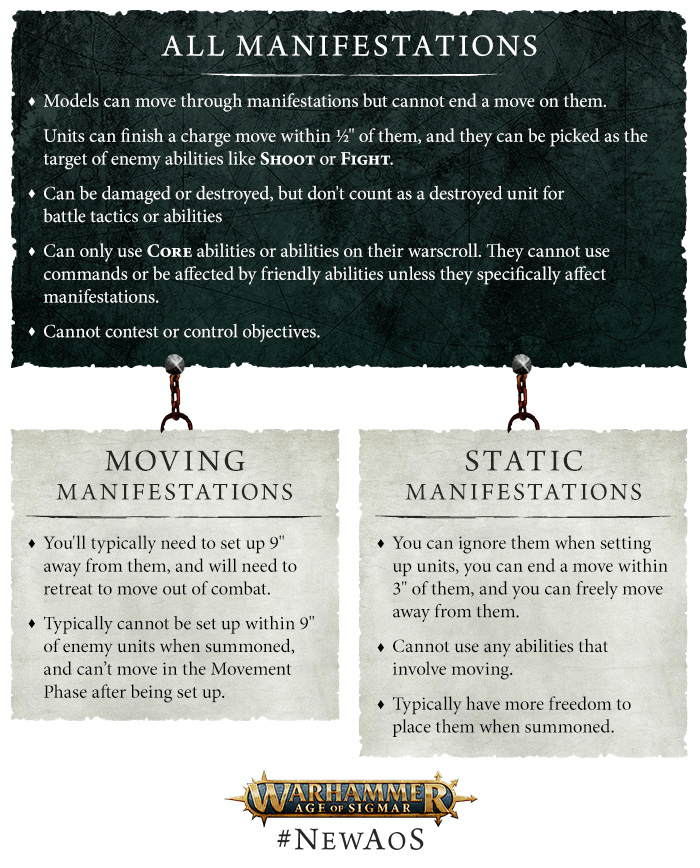
- Manifestation Lore (Endless Spells and Invocations)
- The last one is unique to AOS, in that you literally summon physical spells to the game which can be moved, have health (usually) and have interesting abilities and attack profiles (usually). Again, they’re free, so if you can take it, do it!
- The major difference between 40K and AOS is that enhancements do not cost points in Age of Sigmar. You get to pick one from each of the following:
- Subfactions
- Similar to how in 40K you pick a Faction, then a Detachment to provide special rules to your army, you do the same in Age of Sigmar, except our version of Detachments is called a Formation. Unlike in 40K, there’s no specific enhancements or commands (yet) for Formations, just essentially what boils down to an extra Battle Trait.
- Deployment
- Probably the most important phase of any Warhammer game–it’s typically where games can straight up be lost right then and there.
- In 40K, deploying your units is a 1-1 affair between you and your opponent, strictly alternating deployed units one at a time, creating a subgame of positioning before the first turn has even begun.
- In AOS it’s similar, but different–for the most part, players are going to be adding units to what is called a Regiment, which is led by a HERO and has 0-3 units in the regiment, or 0-4 in the regiment if it is your general’s regiment.
- Just as a heads up, if you take any units that are keyworded as WARMASTER on their warscroll, you have to pick one of your Warmasters to be your general.
- Regiments are one-drops, meaning that once you pick a unit in that regiment to deploy, the whole regiment deploys together. What that means is while a 40K army might have been 8-14 drops, your average AOS army is likely going to have somewhere between 2-4 drops total.
- NOTE: You can choose to deploy units one at a time from a regiment instead of all of them at once, but once you’ve deployed one unit in a regiment, the rest of the units in that regiment have to be deployed on at a time as well.
- Auxiliaries
- You can take units outside of these regiments–these units are referred to as auxiliaries, but there is a major drawback to doing so:
- The player with the fewest auxiliaries gets an extra command point at the start of each round.
- Given that command points are a VERY scarce resource in Age of Sigmar, this is not a good thing. I do not recommend taking auxiliaries.

The Fundamentals – Hero Phase
- Wizards
- Wizards cast spells in your hero phase, and each Wizard in your army knows the spell on their Warscroll (if any) as well as the spells from the Spell Lore and Manifestation lore you chose during list construction.
- Generally speaking, you’ll cast spells by picking a Wizard during your hero phase, declaring the spell, its target, and rolling 2d6 and looking for a result that is equal to or higher than the Casting Value on the spell. If you cast the spell by hitting that number or higher AND the spell is not Unbound, then you cast it successfully, hooray!
- Manifestations will either have a Spell or a Prayer that Summons them.
- Rolling double 1s on a cast is exactly the same as it was on Perils of the Warp–the caster takes d3 Mortal Damage, and cannot continue to cast spells.
- Wizards have a Power Level which tells you how many spells they can cast. It’s the number in Parentheses next to the word Wizard on their Warscroll in the Keywords.

- Unbinding
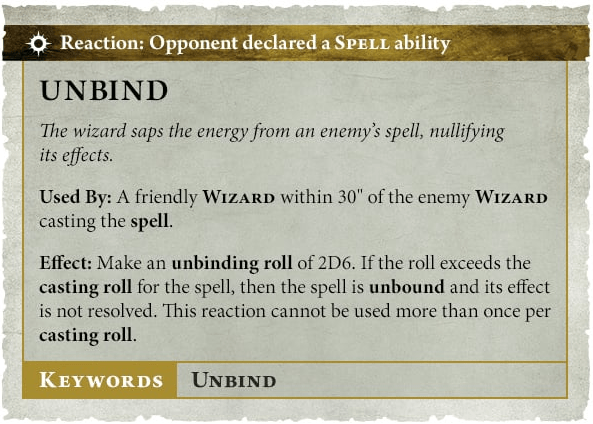
- When an enemy Wizard tries to cast a spell, you can Unbind it–your Wizards can attempt a number of Unbinds equal to their power level. Simply pick a friendly Wizard within 30″ of the enemy Wizard, and roll 2d6.
- If you roll higher than the enemy casting roll, the spell is Unbound and its effects are not resolved.
- Otherwise, the spell resolves.
- When an enemy Wizard tries to cast a spell, you can Unbind it–your Wizards can attempt a number of Unbinds equal to their power level. Simply pick a friendly Wizard within 30″ of the enemy Wizard, and roll 2d6.
- Priests
- Priests pray–who knew? They also have a Power Level which tells you how many times they can pray.
- Priests function similarly to Wizards, but unlike casting a spell, Priests only roll 1d6 when attempting their prayer, and on a 1 their respective God is unhappy with them, deals them one mortal damage, and they stop being able to pray for that turn.

- On a 2+ however, your Priest can do one of two things:
- A) Have that Priest gain a number of Ritual Points equal to the roll, or;
- B) Add ALL of their Ritual Points to the roll, and resolve the prayer–any unused ritual points are lost.
- Most prayers have an additional effect if you get a high enough result–like on an 8+ or 12+ something really cool happens.
- Unlike spells (which can be unbound), prayers can’t be interacted with in any meaningful way.

- Banishing
- In addition to casting spells (for Wizards) and praying (for Priests), both can attempt to Banish manifestations by making a Banishment Roll in your Hero Phase.
- The number of Banishment rolls each Wizard/Priest has is equal to their Power Level–but this number is shared by the number of casts/prayers that the Wizard or Priests can do.
- So a Wizard (2) can cast twice, banish twice, or cast once and banish once.
- The number of Banishment rolls each Wizard/Priest has is equal to their Power Level–but this number is shared by the number of casts/prayers that the Wizard or Priests can do.
- Banishment rolls are made by picking a Manifestation within 30″ of the chosen Wizard/Priest–visibility does not matter–and rolling 2d6. If you meet or exceed the Banishment Value on that manifestation, it’s removed!
- Otherwise, the Manifestation stays where it is, and you are not allowed to make repeat attempts at removing the same manifestation in the same turn.
- In addition to casting spells (for Wizards) and praying (for Priests), both can attempt to Banish manifestations by making a Banishment Roll in your Hero Phase.

The Fundamentals – Movement
- Coherency in 40K and AOS
- In 40K, moving in coherency means models must stay within 2” horizontally and 5” vertically.
- In AOS, coherency is far more restrictive: when you move a unit, each model must remain at least within 0.5” of:
- At least 1 friendly model if the unit has 6 or fewer models, or;
- At least 2 friendly models if the unit has 7 or more models.
- Unlike in 40K, all coherency in AOS is horizontal, no verticality comes into play at all here for coherency–no more measuring or trying to standard the height of floors in terrain, huzzah!
- Verticality
- Look, big tall pieces of terrain or multi-level terrain looks sweet. In 40K, verticality matters quite a bit, especially when trying to draw line of sight or taking advantage of Plunging Fire to get bonuses to shooting.
- In AOS, not so much. Moving over terrain is pretty straightforward:
- Less than 1” verticality? Ignore the terrain piece.
- More than 1” verticality? Gotta have the movement to go up and over it.
- Otherwise, for the most part, you’re going to end up never thinking about height ever in a game.
- Combat Ranges
- In 40K, you have to end your movement outside of the 1″ Engagement Range, which effectively means that in a LOT of cases, it’s impossible to fail a charge.
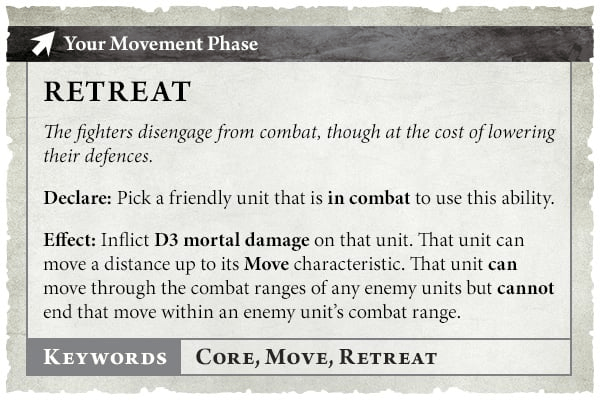
- In Age of Sigmar, you have to end your movement outside of the 3″ Combat Range (unless you have abilities that ignore that, which exist), which means there is a non-zero chance of rolling two 1s on your charge to fail your charge.
- The 3″ Combat Range also means you create larger buffer zones, so in certain cases with a sufficiently large unit or model, it’s relatively easy to box out an entire objective.
- Redeploy
- This is a very, very important command ability present in 4th Edition. At the end of the enemy movement phase, you can pick a unit to use this command–doesn’t matter where they are–and if you do, that unit moves d6″. This can and will make some charges impossible, sneak units onto objectives they normally would not be able to, etc. Just remember that it exists.

- Fly
- You know how you have to measure diagonals through the air in 40K to measure movement over terrain with flying units and all kinds of complexities?
- In Age of Sigmar, you just ignore everything you fly over–you just can’t end your movement in Combat Range unless you have an ability that allows you to.
- NOTE: Flying units in Age of Sigmar never benefit from Cover or Obscuring.
- Deepstriking
- Deepstriking works basically the same way in Age of Sigmar as it does in 40K, with one notable exception–there are no Turn 1 restrictions on deep striking in Age of Sigmar. Go nuts.
The Fundamentals – Shooting
- Shooting Phases Just Aren’t That Deadly (Usually)
- As previously established, Age of Sigmar is not a shooting game, it’s a melee + movement game that happens to have shooting in it. Between Cover (granting -1 to hit for the shooting unit) and the absence of S vs T math, shooting phases are far, FAR less lethal than in 40K. Standing out in the open just isn’t that big of a liability here.
- In addition, while Artillery still exists in the game, the overwhelming majority of shooting in AOS is infantry based, and given the coherency restrictions on movement (alongside overall shorter shooting ranges) means that shooting phases are not nearly as relevant, unless you have one of the few builds in the game that highly relies on it.
- Cover (That Actually Works!)
- Just like in 40K, there’s restrictions to shooting while engaged in combat. In 40K, unless you’re a monster, vehicle, or you have a pistol weapon, there’s no shooting in combat–in addition, there’s no shooting at units engaged directly in combat either. Don’t want friendly fire, after all!
- In AOS, it’s even more streamlined–does your shooting attack have Shoot in Combat? If not, and you’re in combat, you’re not shooting. Simple as that. You CAN, however, shoot into combat at no penalty.
- In AOS, cover works similarly to how it does in 40K–are you drawing line of sight for a shooting attack over a terrain feature that has the COVER keyword? Then cover applies!
- In 40K, cover is on a model-by-model basis, and gaining the Benefit of Cover grants a +1 to save rolls to models that have the benefit.
- In AOS, any unit that’s being shot at while behind a terrain feature OR is wholly within the terrain piece and being attacked (melee or not) is -1 to hit.
- The two restrictions to this rule are that the unit being targeted cannot that turn have charged or have the flying ability.
- A unit is considered behind a terrain feature if ALL of the models in the attacking unit cannot draw line of sight to ANY models in the target unit without that line of sight passing over that terrain feature.
- Lastly, cover in AOS is applied to the whole unit, and NOT on a model-by-model basis.


The Fundamentals – Charging
- Restrictions on Charging
- Charging has, historically, always been a rule that has the ‘need to be within 12″ of enemy units to charge’ clause.
- In a first for Age of Sigmar, there’s no more requirement to be within 12” of an enemy unit to declare a charge. This will inevitably create interesting use-cases for units getting multiple sources of +1 to charge being able to charge/counter-charge outside 12” into an enemy unit.
- Charge Targets
- Once you’ve decided to charge with one of your units, we get to one of the really big differences between 40K and AOS:
- In 40K, you must declare charge targets and–if you fail to reach them with your charge–the unit stays put.
- In Age of Sigmar, you just roll the dice, and if your unit can end within 0.5” of any enemy unit, you’re good to go!
- Once you’ve decided to charge with one of your units, we get to one of the really big differences between 40K and AOS:
- Charging Units on Terrain
- One of the biggest additions to Age of Sigmar is how charging works when an enemy unit is physically too high up a terrain piece for your unit to get to via a charge roll:
- If the enemy unit you are charging is too high up, instead you simply need to end your charge within 0.5″ of the terrain feature the enemy unit is on.
- One of the biggest additions to Age of Sigmar is how charging works when an enemy unit is physically too high up a terrain piece for your unit to get to via a charge roll:
- On Overwatch
- In 40K, Overwatch is a stratagem used in either the enemy movement or charge phases, where you can resolve shooting attacks that only hit on unmodified 6s.
- In Age of Sigmar, there is no direct Overwatch equivalent, with the closest example being the Covering Fire command, which lets you pick one of your units with a shooting attack in the enemy shooting phase to shoot the closest enemy target at just a -1 to hit.
- So, charge away! Did I mention this is a melee game?
- The Counter Charge Command
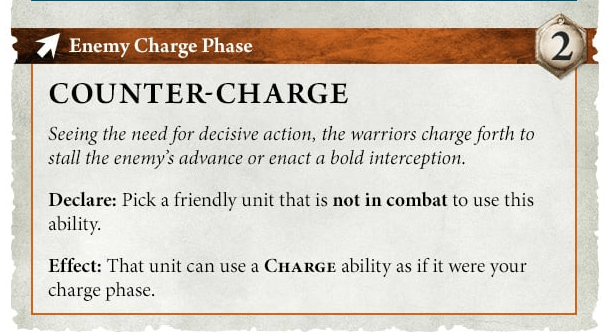
- Possibly the most impactful change in 4th edition of Age of Sigmar is the inclusion of the new Counter-Charge command–contrary to its title, you don’t need to wait until your opponent charges with one of their units to issue it. Instead, if it is your opponent’s charge phase, after they are all done you can issue Counter-Charge to any one of your units and get a charge attempt with them, which makes deepstriking shooting units a real liability because–again–there’s no overwatch now in the charge phase in AOS!

The Fundamentals – Combat
- Alternating Combat
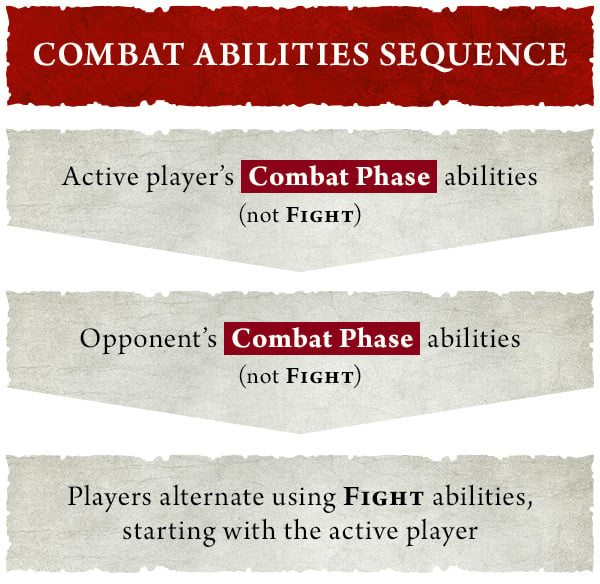
- Here’s something you MUST understand about this game–unless you have distinct abilities that grant units Strike-First in combat, combat is always alternating, starting with the active player. Being on the charge is usually a good thing in this game–cavalry usually getting +1 damage on the charge, for instance–but it doesn’t mean an automatic death sentence if you get charged by, say, an entire army at once.
- Combat Flow – Pile-In
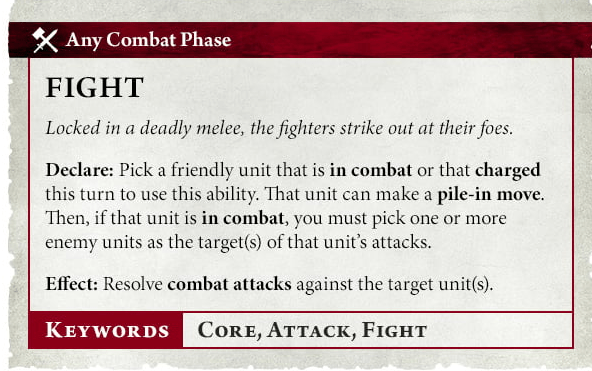
- Once in combat, after all combat abilities have been resolved, you get to fighting, which still follows the rules of “Pick a unit to fight, pile-in, make attacks, resolve damage” like in 40K, except with some major differences in the pile-in step:
- In 40K, piling-in a unit means moving each model in the unit towards the closest model in an enemy unit, ending in base-to-base contact if possible.
- If there’s no enemy unit within range to pile-in to, there’s no pile-in at all.
- In AOS, before piling-in, you must pick an enemy unit that your unit is within combat range of to be the target of the pile-in, then pile-in your unit, but each model must end their movement no further away from the picked unit than they did at the start of the pile-in.
- Unlike in 40K, if your unit is not within combat range of an enemy unit, you can still pile-in, but in any direction!

- Combat Flow – Attacking
- In 40K, if you fight with one of your units and that unit charged, you have to fight your charge targets. If your charge target is dead, and you can pile-into Engagement range of an enemy unit, then you can fight that unit, provided your models are either within 1” of an enemy model, or in base-to-base contact with a friendly model that’s within base-to-base contact of an enemy model.
- In AOS? If your models are within combat range of an enemy unit, make attacks. That’s it. Move along.
- After the fight is over, just be aware that in AOS consolidation is not a thing. At all. Zero. Once you are done fighting, you are done.
- Otherwise combat plays out like it normally would, except in AOS there’s no Strength vs Toughness math–you have a to-wound characteristic which succeeds on one number. In exchange for granularity, you get simplified math which makes combat smoother and faster.
- Strike First and Strike Last
- Just like in 40K, Strike First and Strike Last exist in Age of Sigmar, though with more extensive rules text:
- All Strike First units fight first, starting with the active player and then alternating, and no other units can fight until all Strike First Units that were in combat at the start of the phase have fought.
- In Age of Sigmar, cannot > can/must in all circumstances.
- The above is also true for Strike Last.
- All Strike First units fight first, starting with the active player and then alternating, and no other units can fight until all Strike First Units that were in combat at the start of the phase have fought.
- Just like in 40K, Strike First and Strike Last exist in Age of Sigmar, though with more extensive rules text:
- Applying Damage
- Lastly, there’s damage. In 40K, if, say, a Baneblade shoots a unit of Ork Boyz with its big fuck-off 6 damage cannon, you just apply the damage from that attack until it kills the model the attack was allocated to.
- This, of course, has been an endless sense of bewilderment for me, because imagine being the rest of the boyz staring down the barrel of an apartment block sized war machine, which after firing at you just kills one dude.
- Instead, in AOS all damage carries over, which makes launching your monsters into hordes of little troops is way more effective since if you deal 20 damage to a unit that has 20x models each with 1 health, they’re all dead! (Wards non-withstanding of course.)
- Lastly, there’s damage. In 40K, if, say, a Baneblade shoots a unit of Ork Boyz with its big fuck-off 6 damage cannon, you just apply the damage from that attack until it kills the model the attack was allocated to.
The Fundamentals – The End of the Turn
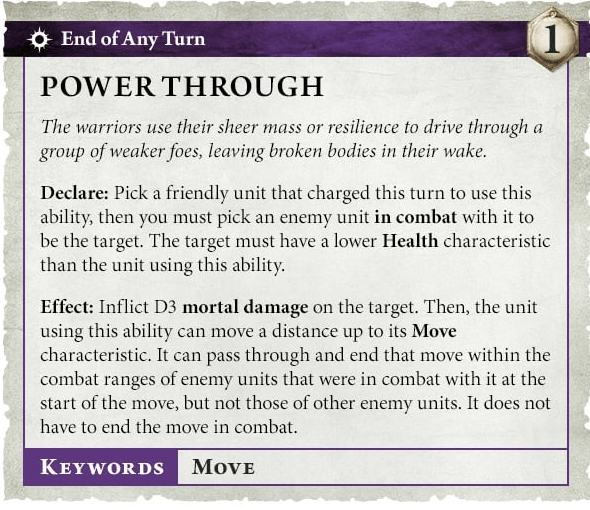
Not a whole lot happens here at the end of the turn. Starting with the active player, they do all of their end of turn abilities, and then the other player does theirs. This is where VP is scored for the turn, which is after all abilities have been resolved. Just be aware of Power Through, which is by far the coolest new command ability in the game, which you can only do with a unit that has charged that turn, but remember that you can, in fact, Counter-Charge on your opponent’s turn, then Power Through that unit onto an objective, among other things.
The Community
I’d like to take a second and talk about something that isn’t talked about enough, and that’s community.
Humans are social creatures, and each of us really enjoy belonging to groups of like-minded individuals, especially when those people share similar interests that we can relate to. Warhammer, after all, is a social game, requiring a non-verbal social contract between players to play fairly and communicate intent and direct action in order to make the game functional. In doing so, norms, mores, and even entire languages develop in order to allow us to communicate and participate better–hence the glossary at the start of this article.
But the thing that is whispered about and not addressed enough is the vibe of a community. What you feel walking into a room full of people who belong to a community where you are an outsider varies immensely from community to community, and this feeling runs the gamut from outwardly hostile to a warm welcome. For the individual entering this community, your reception is going to be dependent on how open the members of that community have decided to be. We have all absolutely been in those situations where we try to join social circles and felt more excluded than included.
Hobby communities have been (rightfully) accused of being exclusionary–either on a financial, cultural, ideological, racial, or even gender level. Wargaming communities in particular have been guilty of this, with members of those communities finding–frankly–creative ways of just being absolute, knuckle-dragging gatekeepers who want to keep their communities pure, and showing borderline hostility to new players.
Not Age of Sigmar.
As someone who has played “competitive” wargames, board games, and collectible card games, I have never been part of a community as welcoming as this one. Hands down. At LVO, 300 Age of Sigmar players will drown out thousands in a room cheering on the players who won the event. Friendships are built at the drop of the hat, stretching across thousands of miles and over years. People will drop out of the game and rejoin it, walking into their local game store and being welcomed back as if no time had passed and nothing had changed.
There is a vibe in Age of Sigmar that is warm, welcoming, and above all friendly in a way that, honestly, doesn’t exist for the most part in our general day-to-day lives. Don’t get me wrong, I genuinely love this game, but I love the people who play it more, because honestly if you don’t love the people who you have to play games with, why the hell would you play that game in the first place?
Wrapping It Up
This was an absolute monster to put together, and I hope I did our 40K friends a service in drawing parallels the best I could.** There’s so much nuance in Age of Sigmar waiting to be unlocked this edition, so I’d like to leave you with a short summary of the big points to remember that will hopefully help you speed up your transition to what we hear at Plastic Craic have come to love most: day-drinking Age of Sigmar.
- The Double Turn is just another thing you need to plan for–not everyone who takes a double turn tables their opponent, and you’ll find yourself giving it away from time to time at your advantage. It is a significant part of the game, but not the dominant one, and learning to master the potential ebb and flow of the game based on that dice roll is going to fundamentally make you a better player.
- 40K is a Granular Game, but Age of Sigmar is Synergy game. For example, having only a To Hit/To Wound roll will feel strange at first, but it dramatically speeds the game up, because in exchange you will find that there are far more ways to create layers of synergy that may not pay off immediately, but create incremental advantages that will make your unbeatable.
- Age of Sigmar is melee focused, not shooting focused, but shooting-first builds exist out there. Because of the 3″ combat range, anything with a 40mm base or higher is going to stand on the objective itself, and so to take that objective you’re gonna need to charge it. There’s no tip-toing anymore–the time for peace is over, and only war remains in the Mortal Realms.
- This is the best community you will ever be part of. Seriously, give it a shot.
- Elves are still bullshit in this game, too.
*All picture credits and courtesy of Games-Workshop.
**And if it wasn’t, write your own thesis length article!

If you’d like to help us continue our work, we’d love to have your support. All Patreon Tiers include Discord access, exclusive articles and regular contests. Our Tiers are priced to be within everyone’s reach, so please click here to join us today!




 Plastic Craic
This is a really great article and helpful in a bunch of ways. Thank you for taking the time to write it.
LikeLiked by 1 person
Thanks mate. Glad you found it helpful!
LikeLike