
by Calvin Rarie
By far one of the most exciting changes to the game–but not to your wallet–is that everyone gets free Endless Spells–err, Manifestations! By free, I mean they don’t cost points anymore, of course. Now that the end is in sight and we’re starting to get a bigger picture of the details, we’re gonna take a look at the Universal Manifestation Lores that everyone has access to–we’ll cover the faction specific ones when we take a look at those factions in particular. On that note, if you want to help us decide which indexes we should review first, Patreon members (link at the bottom) get to vote on which they want to see!
Anyways, we’re going to be rating the Lores themselves, and thanks to the fantastic, giga-chad, and all-around great human being AOS Coach, we have all the information we need to assess them in a vacuum. You can see his thorough breakdown of each manifestation here, which is well worth the watch–and remember to like and subscribe so he can continue to put out that great work!
Quick Rules Reminder Regarding Manifestations
Manifestations have a bunch of new rules now, which really are categorized into how to cast/banish them, and then the rules for them actually being on the battlefield. In addition, when you build your army list, you get to pick one Manifestation Lore to bring along with you, and all of your wizards gain access to the spells to summon them and/or your priests gain access to the prayers to summon them.
Regarding how to cast/pray/banish them:
- Manifestations have a casting/prayer value that you have to meet or exceed, and the spell will tell you the summoning distance as well any set-up restrictions.
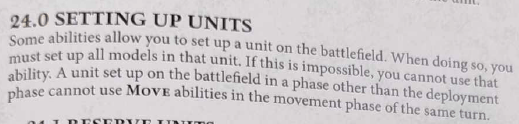
- Regarding set-up, for Manifestations that move in the movement phase they will not be able to move after being set-up, as the new Core Rules restriction on setting-up units during your turn prevents them from moving during your movement phase the turn they come out. Possible FAQ incoming for this one, since Manifestations are only treated as units in specific circumstances.
- Banishing a Manifestation requires you to roll 2d6 and meet or beat the Banishment Value (BV) for that Manifestation–the BV is found on the warscroll for that manifestation.
- Remember that Banishment attempts are once per Manifestation per turn, AND the number of Banish attempts each Wizard has is equal to their Power Level minus any casts/prayers they’ve attempted that turn.
- Banishments are done ONLY on your turn, no more “dispel” attempts in your opponent’s hero phase.
- Manifestations can also be dealt damage to destroy them (i.e. you can punch them right off the table now), or if the hero that summoned them dies, the manifestation is also destroyed.
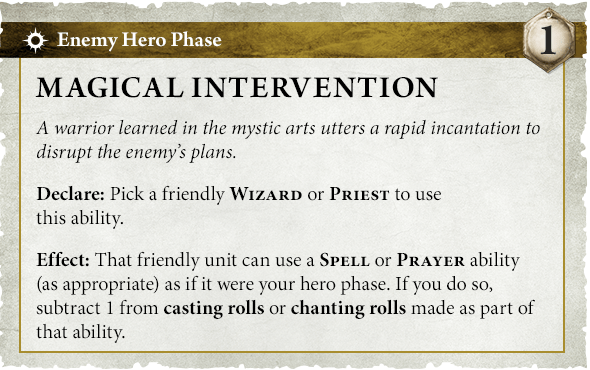
- The Magical Intervention command can also be used to summon a Manifestation on your opponent’s hero phase, but remember that you will cast/pray with a -1 modifier.
- Important Note: Because the Active Player does all their abilities first each phase, and then the Opposing player does theirs, that means casting a Manifestation on your opponent’s turn means they cannot banish that Manifestation.
Regarding the rules for Manifestations once they are on the table:
- To make things easier, we need to define the two categories that Manifestations fall under, which I am going to describe as Predatory and Static. These terms of Predatory and Static are just terms we are using here to facilitate discussion about the Manifestations themselves; they are not Core Rules terms.
- A Predatory Manifestation has a movement characteristic, while a Static Manifestation does not (it has “-” as its movement characteristic).
- Both types of Manifestations can be moved through by your units, but you cannot end a move on them.
- Predatory Manifestations:
- Are units for the purposes of movement, combat range, being in combat, and for setting up other units near it. They can also be charged like normal.
- Can use CORE MOVE abilities, and if they have melee/ranged weapons, they can use the CORE FIGHT/CORE SHOOT abilities, respectively.
- i.e., they can charge, move, run, etc.
- Cannot receive Commands, as they are not CORE abilities.
- That means no Counter-Charging.
- Are effected by enemy abilities that TARGET units, but not by enemy abilities that DO NOT TARGET enemy units–e.g. -1 to hit auras.
- Usually have to be set up more than 9″ away from enemy units.
- Static Manifestations:
- Work the same as Predatory Manifestations, but with the following exceptions:
- They are only units for the purposes of movement, combat range, being in combat, and for setting up other units near it IN THE CHARGE AND COMBAT PHASES. They can also be charged like normal.
- Cannot use CORE MOVE abilities due to having no Movement Characteristic.
- Usually can be set up within 3″ of enemy units.
- Work the same as Predatory Manifestations, but with the following exceptions:

Note the potential gotcha in that penultimate bullet point. They are not treated as units in the movement phase, so you can walk right up to within combat range of your opponent’s Manifestations in that phase. But then when the charge phase rolls around, at that point you’ll be locked in combat and unable to charge off. Don’t do that!
Just be aware of another trick that works really well, too–you are incentivized to cast Manifestations on your opponent’s turn, since Predatory Manifestations cannot be moved in that turn’s movement phase after being set up anyway. As for Static Manifestations, I fully anticipate there being a Day 1 FAQ that keeps those types of Manifestations from locking your opponent’s units into combat with them during the charge phase and preventing charges because, uh, that’s pretty strong.
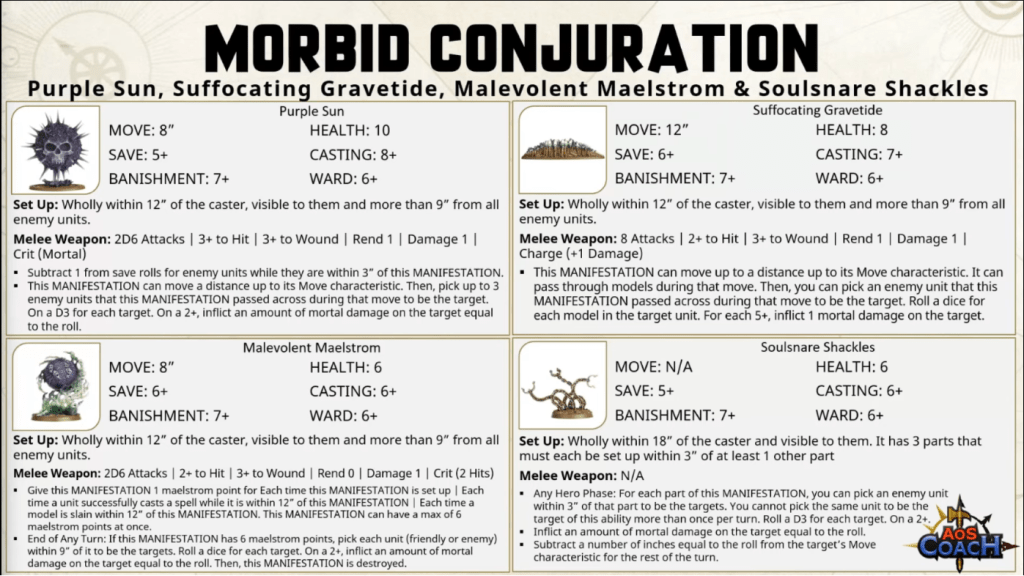
Each screenshot from Coach’s video breaks down all the important numbers for you to remember for each of the Manifestations, so let’s jump into each of the lores!
Manifestation Lores
Morbid Conjuration
Calvin’s Rating: Easy A
Starting off with an ABSOLUTE BANGER of a lore here! This is the one I’m most hyped up for at the moment, as each one of these Manifestations have a dramatic impact on the battlefield once they are there.
Starting off the with the Purple Sun, there’s been some dramatic changes here–no longer does it suck things off to death, but instead doing d3 mortal damage to anything it passes over. So swallowing Archaon to death is not longer a thing that happens, but instead layers on extra damage when it moves over units. Be mindful of combat ranges, though, since to touch an enemy unit it will need to move 3″, then over the base of the enemy model, then back 3″ since it cannot end in combat. The real sauce, though, is the -1 to save that only applies to enemy units now. The only bummer is that is banishes on a 7+ instead of the 9+ that it used to be in 3rd Edition, but it is still impactful.
Suffocating Gravetide is both better and worse at the same time–opening up extra charge distance on such a gigantic base is a big deal. That said, if you manage to cast this using Magical Intervention on your opponent’s turn and then get both a good move and charge off, this bad boy can do some serious damage!
The Malevolent Maelstrom does basically the same thing it did before, but with two big changes.
- It can’t move on the turn you cast it anymore, so no loading it up and then popping it into your opponent’s lines. This is a big deal because it blows up at the end of the turn, and hit friendly AND enemy units, and;
- The fucking thing does d6 mortal wounds now, because you just roll a dice–not a d3, your regular ol’ d6s. Imagine casting this one your opponent’s turn and dropping it right behind one of your expendable units and using it as a nuclear landmine.
The big, big, BIG winner in my opinion is the Soulsnare Shackles. At an 18″ summoning range and being a Static Manifestation means you can drop this into your opponent’s lines early on, and now the pieces each string out rather than bubbling around each other. Bonus points for casting this using Magical Intervention, because:
- You are reducing the enemy unit’s movement characteristic on their turn, and;
- Because it’s a Static Manifestation, if the enemy units fail to move far enough away from it, they get locked into combat with it during the charge phase, which means no charges for those units.
- On your turn, it means no counter-charges, because they are locked into combat during the charge phase!
I’ll be honest, I’m really high on this lore. I see myself taking this most of the time, unless faction specific Manifestations blow it out of the water.
Twilit Sorceries
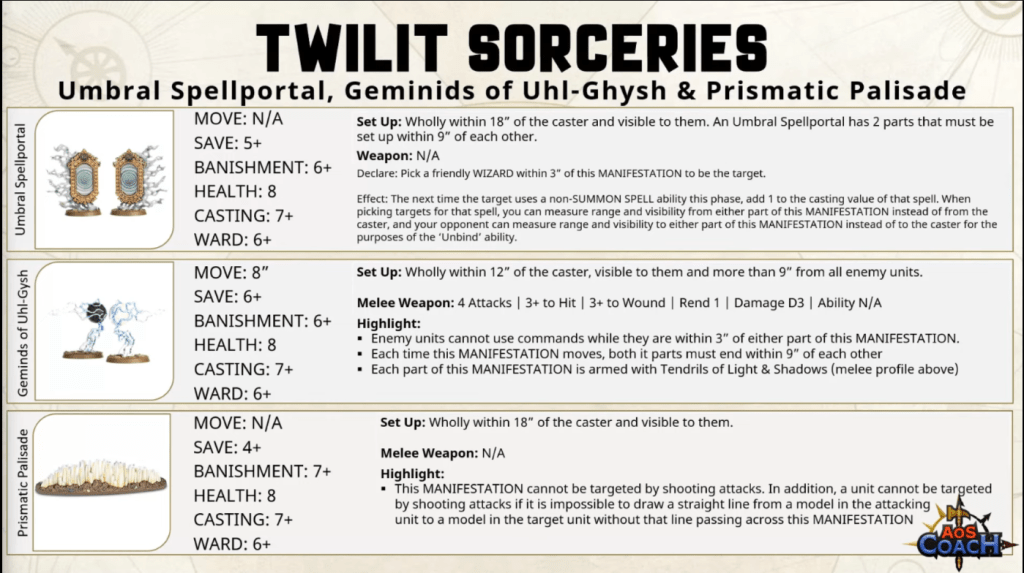
Calvin’s Rating: B+ for Magic Armies, otherwise a C+
This is a tough one to evaluate, to be honest. Umbral Spellportal more or less does the same thing that it did before, just adding +1 to the required casting value of whatever spell you push through it. Being a Static Manifestation means–again–you can lock enemy units into combat with it, and casting through it using Magical Intervention is a tasty trick, but that depends on the spells being cast through it. I can see the Magic Heavy armies wanting this pretty much all the time, but for anyone else? Probably a skip.
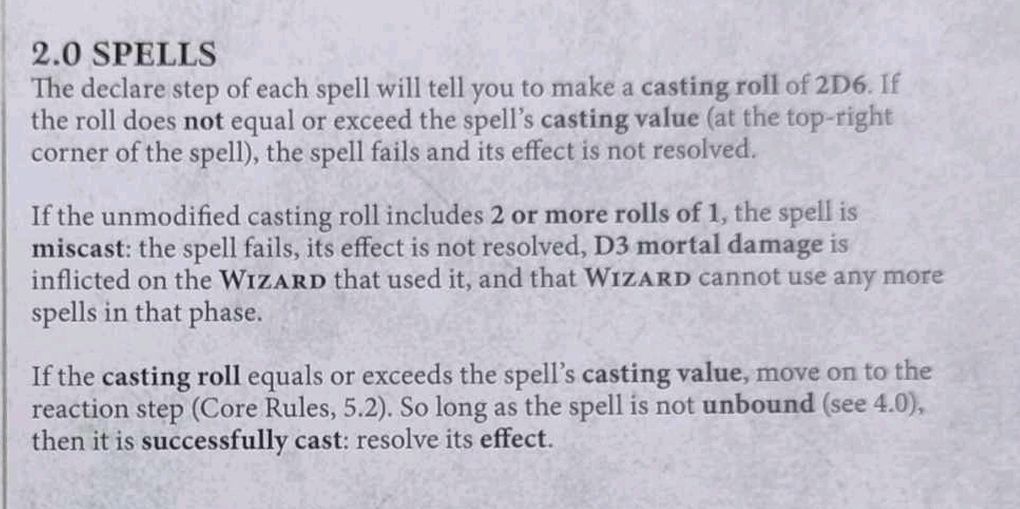
Shoutout here to bloodbathNbeyond for pointing out in our Discord that casting roll and casting value are two very different things: since the Portals are increasing the casting value of the spell, they are making it harder to cast, not easier.
Geminids are WAY different now, since you have to actually be in combat with them to turn commands off, but they have a respectable combat profile coming out to a total of 8A/3+/3+/-1/D3 Damage. It’s pretty amusing to cast this during your opponent’s turn to potentially make charging one of your units annoying, since you’d be turning off All-Out Attack/Defense during combat, or any other annoying commands – noting that it affects enemy units only.
Prismatic Palisade got a MASSIVE glow up, now just straight-up acting like an Obscuring terrain piece, except it also blocks line of sight to your flying units too. However, you’re gonna have to really plot out your opponent’s shooting ranges to maximize the use of this, so how often that will work out is gonna depend heavily on your opponent, the terrain, and the movement of their shooting units.
Forbidden Power
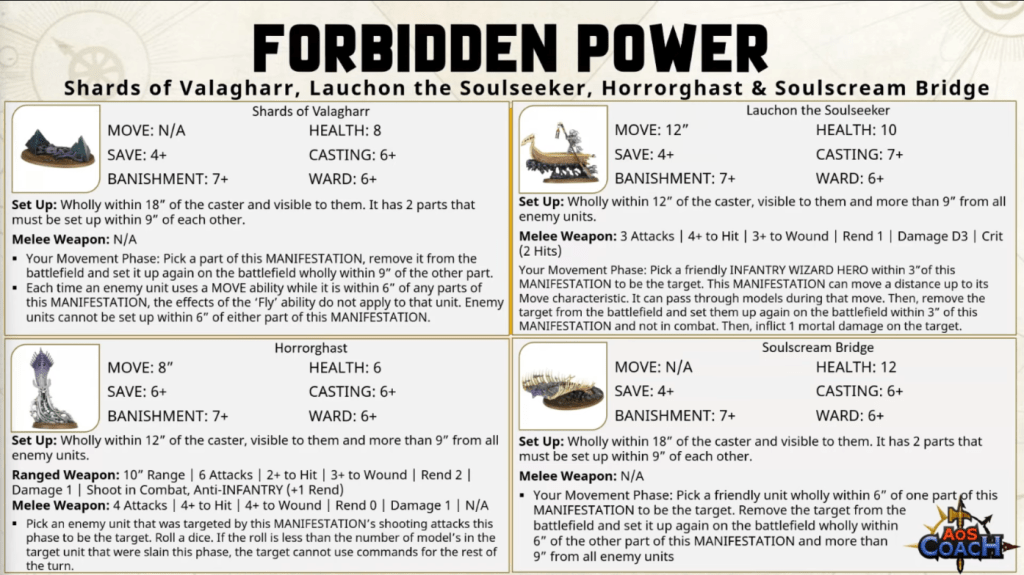
Calvin’s Rating: A if you can maximize the Bridge, otherwise a C+/B-
The Soulscream Bridge is back to being really good! It no longer prevents commands from being issued to the unit that jumps through it, is pretty easy to cast, and the parts just have to be within 9″ of each other. If you’ve got slow units and Wizards, you’re gonna love this. Bonus points if you have big bonuses to charging.
Lauchon got a fairly substantial nerf here–it would normally work like it always has, Uber’ing around your heroes, except you can’t do it the turn it comes out. Since that’s ALL it does, unless you’re spending a command point to cast it on your opponent’s turn, I don’t see myself using this often, and definitely not for a CP. Could be wrong though!
Shards of Valagharr got slightly better, since you no longer have to play a dumb mini-game in trying to snag a unit between them. Instead, in your movement phase you teleport one of the pieces somewhere wholly within 9″ of the other piece, and any enemy units within 6″ lose FLY and no enemy units can be set up within 6″ of it. Not bad, and it will be fun to stop people dropping straight onto an objective, but technically this Manifestation can actually help your opponent out since losing the FLY keyword lets that unit benefit from cover. Remember this is a Static Manifestation, so you can teleport a piece as close as you want to an enemy unit.
Horrorghast is a really nice treat and is 100% different now, since Battleshock is gone–basically, it has a pretty good, short range shooting attack that turns off commands to anything it shoots, as long as you roll a dice and hit a result equal to or lower than the number of models slain by the shots. Against low wound Infantry? No brainer. Single Model Units? Absolutely not, unless you need the chip damage. This is the rare Predatory Manifestation that can actually accomplish something on your turn.
Primal Energy

Calvin’s Rating: Solid C+, higher if you can get charges off with Gnashing Jaws
Gone is the weird mini-game for the Burning Head–instead it just shoots and attacks and is a cheap summon. Being tied to d6 and 2d6 attacks for shooting and combat respectively means that you aren’t going to reliably do damage with it–but sometimes all you need is just one extra source of damage to tip the scales. Just don’t rely on it.
Gnashing Jaws is also different, no longer dumping out randomly high amounts of mortal damage to slow units. Instead, it can do some REALLY high amounts of damage on the charge, and does impact mortal damage on the charge. It also can’t be auto-banished, instead taking a flat 6 damage if someone successfully does a banish roll against it. Overall, really good if you can connect with it, but other than being on a big blocking base it’s all damage and no tech.
Emerald Lifeswarm gained a bunch of consistency in its healing at the cost of only healing your units during your movement phase. Gargants love this thing if they take the Glowy Lantern, since it now just heals a flat 3 damage instead of d3, so between that and Rally you can consistently top up a Mega. That said, it no longer returns models to the table, so no more topping up wounded units of Vanari Wardens and the like.
Aetherwrought Machineries
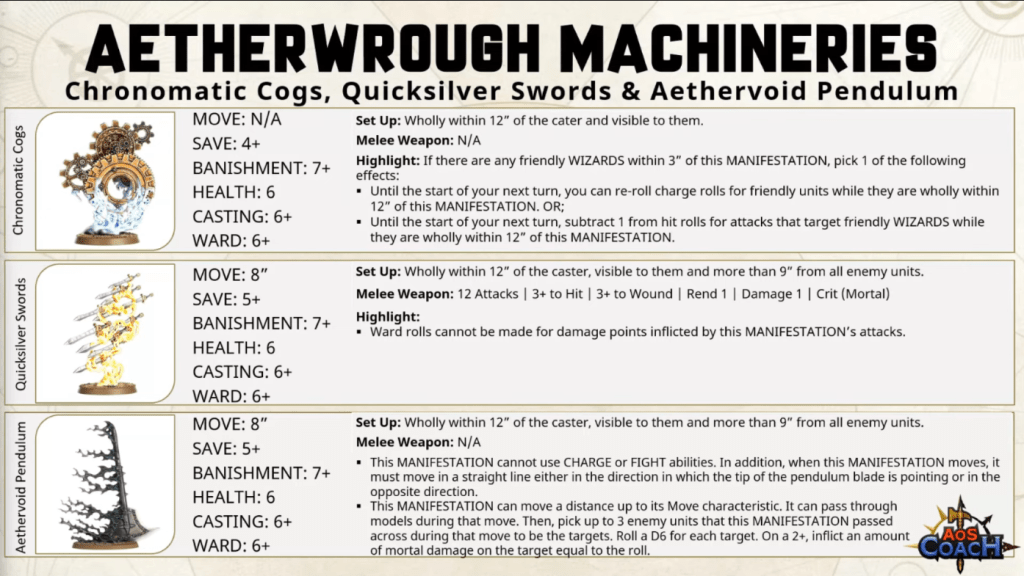
Calvin’s Rating: C-, B- if you have a Casting Castle
Chronomatic Cogs are back, and have a big change, losing that weird extra “Mystic Shield/Arcane Bolt” rule since those two spells are gone now. Now it’s a Static Manifestation that has a 12″ wholly within bubble that either enables free charge re-rolls or -1 to hit rolls for attacks that target friendly wizards. If you’ve got a bunch of Wizards who hate being attacked, it’s pretty good to have around–otherwise, hard pass.
Quicksilver Swords is pretty much the same as before, except it just straight up makes normal attacks that happen to do mortal damage on 6s. The problem–like with all other melee manifestations–is that unless you’re using Magical Intervention to cast them, they do basically nothing the turn it comes out since it can’t move, and relying on 9″ charges for Manifestations that can’t receive Forward to Victory to re-roll their charges is asking for trouble.
The Aethervoid Pendulum got significantly worse, despite it being one of the few sources for d6 mortal damage in the game. It’s a Predatory Manifestation that can’t charge, so it does LITERALLY NOTHING the turn it comes out unless you’re trying to push it through on your opponent’s turn, and even then you have to be able to move it on your turn, touch an enemy model in movement, and end movement outside of that enemy unit’s combat range to FINALLY get a shot at doing mortal damage to it. That’s way, way, way too much set up for too little pay off.
Krondspine Incarnate

Calvin’s Rating: Completely Meta Dependent
The king of NPE is dead, long live the new Krondspine! At last, you can actually kill this fucking thing in one turn, hooray!
This is a very hard unit to assess, since at a CV of 8+ it’s hard to cast for most normal armies, and hard to banish as well. I suspect that armies like Tzeentch, Seraphon, or anything else that can get a +2 to cast or better will like the new Krondspine, while most others will have a hell of a hard time getting this on the table.
While ON the table, however, it’s a relatively tough monster-equivalent that has cute 3d6 charge capabilities as long as it charges an enemy Manifestation. At 6A/4+/2+/-2/3 Damage, it hits fairly hard, and cannot be debuffed by -1 to hit auras since Manifestations ignore enemy abilities that do not target units. This is a Manifestation assassin, and something that really benefits from you being able to kill those Manifestations without having to rely on Banishments, which eat into the number of casts you have each turn.
If you can reliably cast this thing, go for it! If you have no bonuses to casting, I would think hard before taking it.
Wrapping It Up
If I had to guess, you’re likely going to see the Morbid Conjuration the most–being four different Manifestations that each do something different is just way too much value. Additionally–and this is personal taste here–I feel like Predatory Manifestations that don’t do anything without charging create liabilities for you, since it just makes it easier for your opponent to charge them instead and get extra movement that they wouldn’t get otherwise. Age of Sigmar is, after all, a game of movement first and foremost, so anything that denies movement is inherently a good thing.
My top three manifestations out of all of them would have to be:
- Soulsnare Shackles for the movement blocking capabilities it unlocks;
- Krondspine Incarnate if you can reliably cast it, because this is probably going to be the Manifestation meta;
- Soulscream Bridge if you can really take advantage of the teleporting, then it’s an all-star, because if you’ve got anything that can 3d6 charge or get bonuses to charge out of it, you’re going to dominate fights. Bonus points if you teleport a roided-up shooting unit to rain hell on your opponents. Apologizes for triggering anyone who suffered through buffed up units of teleporting Irondrakes back at the start of 3rd edition.
What do you think about these Manifestations? Let us know!

If you’d like to help us continue our work, we’d love to have your support. All Patreon Tiers include Discord access, exclusive articles and regular contests. Our Tiers are priced to be within everyone’s reach, so please click here to join us today!





 Plastic Craic
4 thoughts on “Rating the Universal Manifestation Lores”