

Thanks to our guest writer The Aussie Wargamer for this article.
“I’m just not a creative person,” she said, glaring at me with the kind of look that might have turned ancient Greek adventurers to stone.
It’s 2:30 pm, and I’m trying to draw out an idea from a student, who is as enthusiastic about the task as she would be if she had to high five a Great Unclean One. It got me thinking though – It’s clear creativity comes easier for some people, but is it intrinsic to who we are as human beings? Can you learn creativity?
The short answer is yes, creativity can be learned and fostered. There’s some really interesting research done on the topic, which I’ll link at the end of the article. I find it fascinating in the education space, but it’s also really interesting when you apply learning and fostering creativity to the Warhammer space.
I think every aspect of the Warhammer hobby – building, painting, playing, lore – can be considered creative. We tabletop gamers are a curious bunch, the kind of curiosity that draws us to learn new things and combine information in interesting and unusual ways. That’s the essence of creativity.
“But Aussie,” I hear you ask, “How can I learn and foster creativity as a hobbyist and player?” Good question my curious friend. Come sit at my feet and bask in my wisdom! Seriously though, I’ve been teaching creativity to teenagers for over 20 years, and here’s what I’ve learned in that time.
1. Play.
It feels a bit odd to encourage a bunch of tabletop gamers to play, but in my experience, it is the most effective way to be creative. This whole glorious thing is wrapped in play, like a burrito of curiosity. We underestimate how important play is, even for adults. We learn through play, we create through play, we feel challenged, we cooperate, we compete, we focus, we relax and we find joy in play. This wonderful hobby of ours is meant to be fun, so have fun with it! Play around. Paint some models in way you never have before. Try a new way to use your favourite unit in a game. Rifle through your bits box and convert something in an unexpected way.
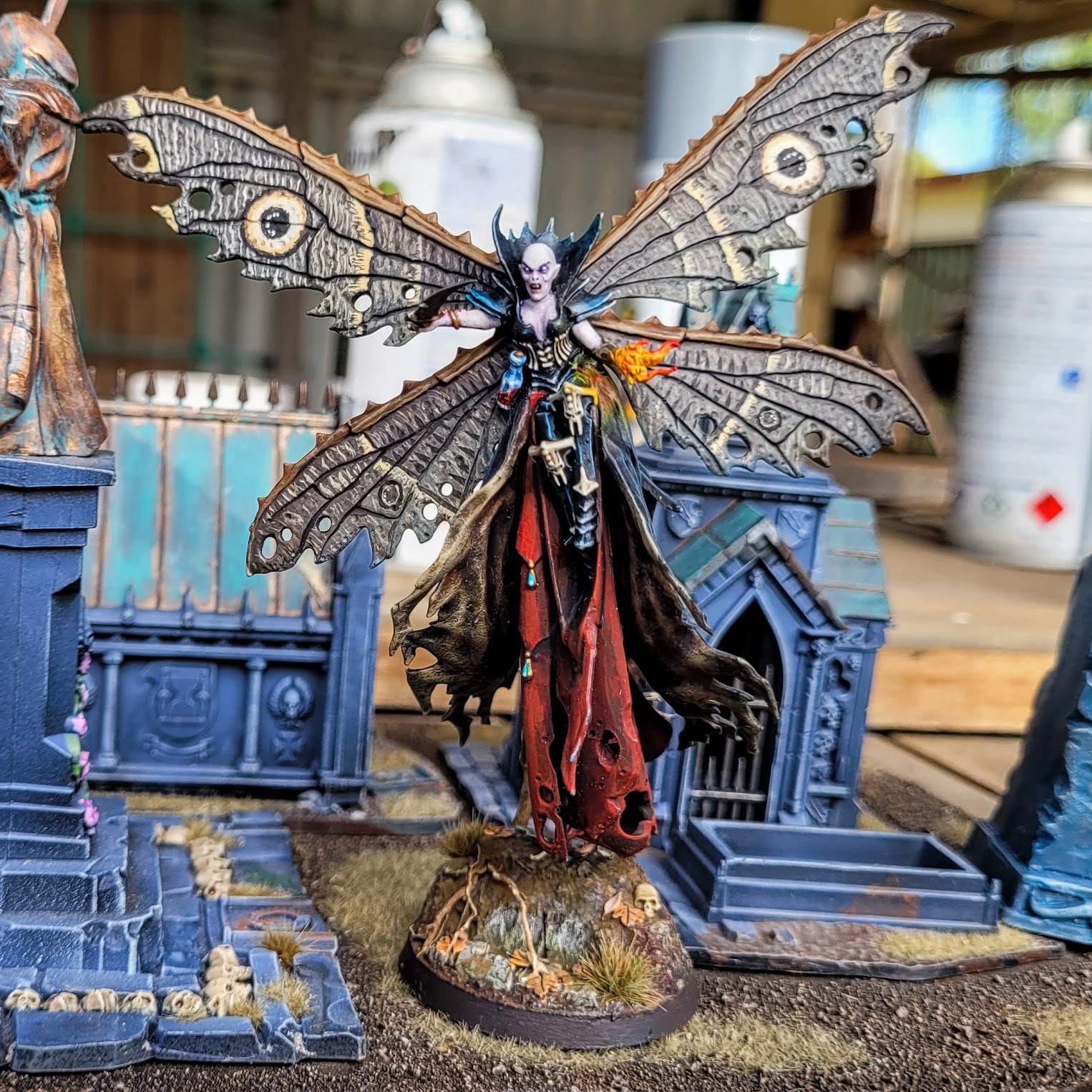
This model came about simply by sifting through my bits boxes.
This can be scary, and often we can have the same mindset as Lady Macbeth after ball-busting her husband to kill the king – “What’s done cannot be undone”, she says. But Lady Macca is dead wrong. Not least for inciting regicide, which, let’s face it, rarely leads to a happy life. My point is, and I acknowledge this analogy has gotten away from me a little, that there’s not much in this hobby that can’t be undone. A few licks of paint, a bit of putty or a mutually-agreed-upon takeback is all that’s needed. Be creative for no other purpose than having fun. This will inevitably lead to failure, and that’s exciting!
2. Be excited to fail, and learn from it.
A colleague of mine loves to tell her students that wrong isn’t bad, it’s just wrong. This is how I look at failure as well. Failure is really important for progress and learning. I struggled for the longest time when the idea in my head and the final product were about as similar to each other as a book and its film adaptation. But a much healthier mindset, and one that is more conducive to fostering creativity, is to see failure as a tool, and something to learn from. If you want to get good at playing Warhammer, you have to lose. That’s how you learn your weaknesses in the game and what you can do to improve them. Likewise, if you want to get good at painting miniatures, you have to be open to failing and learning.

Mouths are basically just a single brown line, right? Right?!
I’ve never been a fan of the old adage that practice makes perfect, because it doesn’t. INTENTIONAL practice, that is practice with the specific goal to improve, makes BETTER. Not quite as catchy though. For me now, being creative is most satisfying when the focus is on the process, not the product. Often people tend to think that if the final result doesn’t live up to their expectations, or what people might consider “good”, then it’s a failure. I think that’s really unhelpful. Make bad art. You’ll learn lots and be more likely to want to make more.
3. Set goals, but don’t feel pressure to reach them.
You can’t force creativity, not successfully, anyway. I don’t like the idea of being creative because I’m making myself be creative. Having said that, goal-setting is not about restricting creative freedom, rather goals can be helpful to give you the drive and motivation to succeed creatively. They’re also really useful to track and measure progress: How have I grown and improved as a modeller/painter/player? Tournament deadlines, hobby streaks and personal goal setting can all help to view things in new ways and push boundaries.
On top of all this, goals provide much needed accountability. A constant temptation for me is to just sit around and get sucked into the black hole that is YouTube Shorts. Seriously, those things are 40 seconds of pure dopamine-fueled addiction. Goals help me focus on the things I want to achieve and minimise the distractions in my life.
4. Organise your ideas.
I have a folder of photos on my iPad that contains images I think would be fun to draw, or artists (both miniature and otherwise) with styles I want to try to emulate. I also use pinterest to organise things I like and can draw inspiration from (the polite artist word for ‘steal’). This can be really helpful to flick through from time to time when I’m forming ideas in my head. This is particularly useful when I’m working through an army theme. Being able to grab and organise images for colour combinations, tone, conversion ideas, patterns, textures and so on can get the creative juices flowing like liquid amber at a Measured Gaming event. The danger of course can be spending too much time looking for inspiration, and not enough time actually creating, so be careful of that.
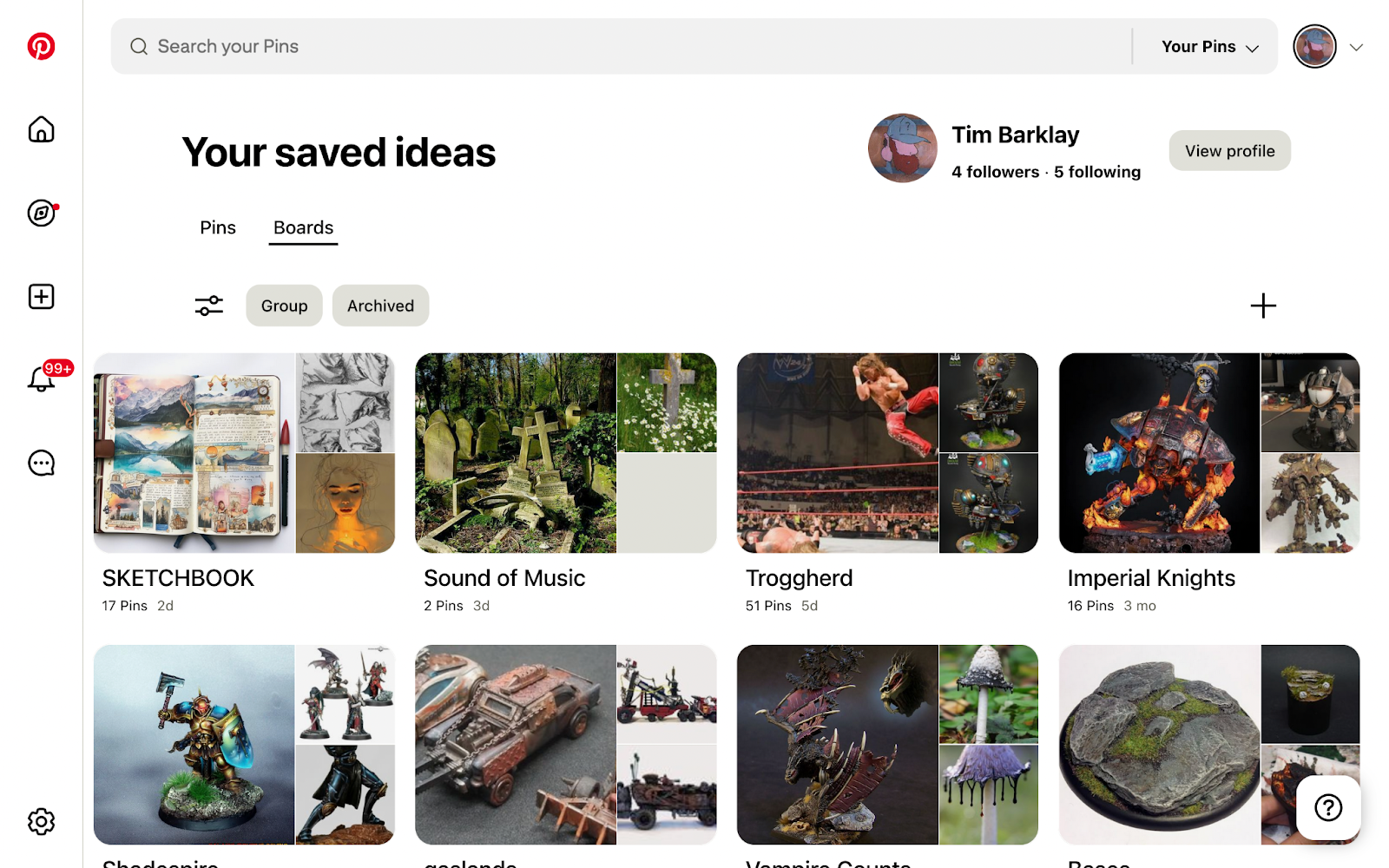
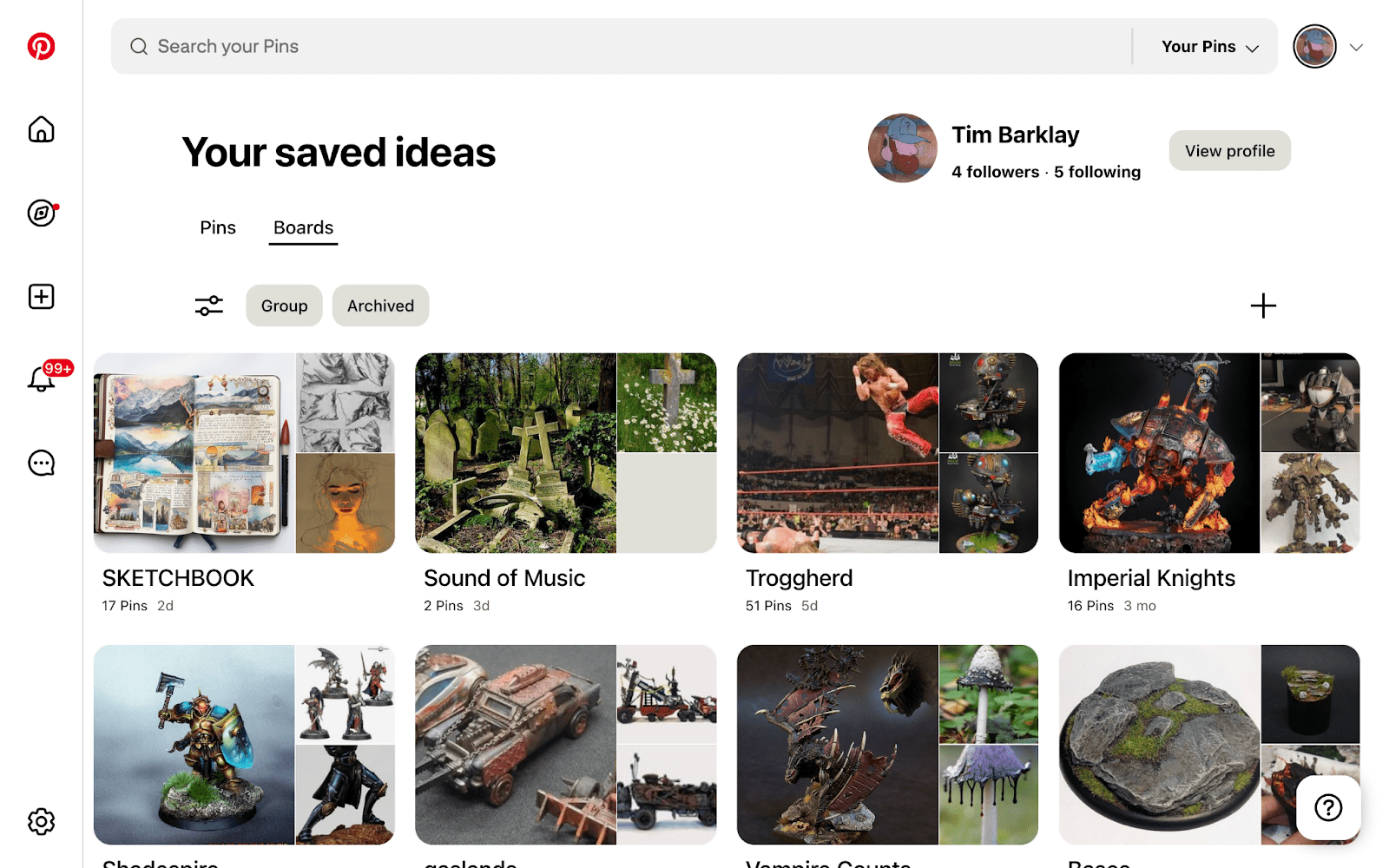
All my projects start as a pinterest board.
And finally, 5. Find creativity in the mundane.
This one works for me, but your mileage may vary. Dance when you do chores. Doodle in the margins. Cook a meal you’ve never cooked before. Pretend play with your kids. Throw the odd musical sting into your conversations. Be creative at the speed of life.

Further reading
I hope you enjoyed this article and got something out of it. If this topic interests you, here’s a couple of articles I found interesting and helpful about learning creativity:
https://www.apa.org/monitor/2022/04/cover-science-creativity
https://www.educationtoday.com.au/news-detail/Can-Creativity-be-Ta-6433
And you are most welcome to follow me on BlueSky, where I share photos of my own conversion work.

If you’d like to help us continue our work, we’d love to have your support. All Patreon Tiers include Discord access, exclusive articles and regular contests. Our Tiers are priced to be within everyone’s reach, so please click here to join us today!





 Plastic Craic
I had a visceral emotional reaction to this…thank you
LikeLike