
Boy, a lot of shit has been spoken about Games Workshop since that Times article came out. A lot of shit. I’ve never really written much about the GW PLC side of things but I am reasonably well qualified to talk about it, and I’ve been stirred into action on this occasion by the abysmal quality of the online discourse in general, and on YouTube in particular. I’ve explicitly told YT to hid the real bottom-feeder channels so I’m pleased to say that I’ve avoided their “takes” entirely, but the videos that have come up on my feed have followed a general pattern:
- Guy who knows nothing about business finance reads out the newspaper article
- Same guy who knows nothing about business finance pontificates about their own pet reasons for why this is the case:
- None of which are business reasons
- Most of which are some variation on “The new Space Marine minis were crap” or “They charge too much”
- Same guy who knows nothing about business finance concludes with a rant about how either:
- The people shorting GW don’t know what they’re talking about, and they should shut up; or (more often)
- The dam has cracked and GW are about to get their well-deserved comeuppance, and maybe even go broke1.
Now the thing is, while some (not all) of these points do have their own merit, they’re not really sound reasons for GW’s share price having dipped. So today’s article will be a myth-busting exercise about what is and isn’t going on.
Ready? Let’s go.

A note for my fellow finance professionals
There will be a lot of times in this article when you’re going to say “But….” And you’ll be correct. Just remember that our target audience is not active in this field and we’re trying to help cut through the murk. If you think that something I’ve written misses some nuance or should go deeper to make a point more accurately, I am unlikely to disagree – but we’ve also got to bring people with us here. A lot of what I’m about to say would be more correct if it was more detailed, but if the cost of being more correct would be losing the normies, it’ll do more harm than good. You’re still welcome to comment, just bear in mind that if you already know what WACC2 stands for you’re well ahead of the target audience.
How shares are valued
Let’s kick off by identifying what this £480m actually represents: it’s a not a “loss” in the sense of GW’s costs exceeding their income (that didn’t happen), and GW certainly didn’t see half a billy disappear from their bank account last week. It’s a drop in their share value, not their profitability.
If you take the price of one share in a company and multiply it by the total number of shares in circulation, this is known as the market capitalisation (aka “market cap”) of that company, and it’s GW’s market cap that has declined. The business itself hasn’t lost any money – people who are trading the shares just don’t value them quite as highly as they did a couple of weeks ago.
For a bit of context, this is what their market cap looks like over the last 10 years:
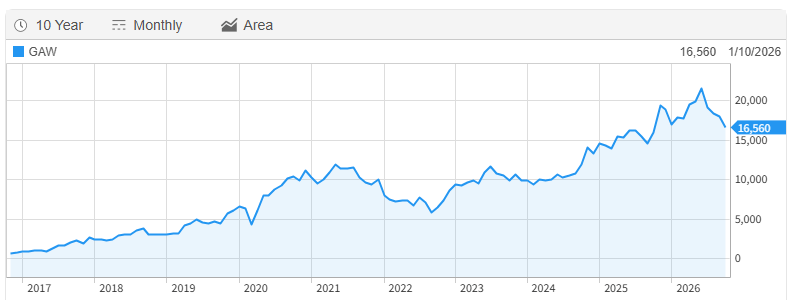
So GW’s market cap has declined, but from a very high level. Most shareholders won’t even be sitting on a paper loss: for the majority it will be a small reduction in the substantial gains they have enjoyed.
That’s still bad, right?
A drop of 8% over a couple of weeks is not trivial for a big company like this: it’s well outside the normal short-term ups and downs and beyond anything the market as a whole has done in that time. And “number gets bigger” is always better than “number gets smaller”. But this doesn’t mean that GW itself is suddenly running at a loss: it simply means that the market now estimates that they will continue to grow their profits more slowly than they previously estimated. But I’m going to repeat that important part in bold, because it’s important: continue to grow their profits.
Huh? How can the share price go down if their profits are still growing?
Well that’s really the crux of the matter. There’s a few ways that listed companies can be valued: meme stocks are there own phenomenon, and GW definitely is not a meme stock. So leaving them to one side, as a floor, you could look at the value of the company’s assets if they ceased trading and sold them off for parts. But most business intend to keep trading (known as a “going concern”) and would hope to use those assets productively, to return more money over the long haul than their trade-in value, and that’s the most relevant way of thinking about GW PLC.
So in simple terms: for a going concern (like GW), the share value should be loosely based on the total value of all the money it will bring in (after tax) over the long haul, since that money will ultimately flow to investors. Fundamentally, that’s why you want to own the shares, right? The business will make a profit and those profits will flow to you, your own thin slice of heaven. We’ll illustrate that with some simple numbers but first let’s go one smidge more complex than that and look at the discounting.
If you put your money in the bank for a year, you would earn interest, and that interest compounds over time. Apply the same logic but in reverse: money you will receive in 5, 10 or 20 years’ time is worth less than having that same amount as cash in hand today (since you could have used that money to earn a return in the meantime). Marking down the money that you will receive a few years down the line to its equivalent value today is known as discounting.
So let’s have a simple illustration, and we’ll park inflation to one side for the moment. Imagine you have an investment opportunity that will return $100 cash to you in 12 months’ time, and that return continues to grow by an extra $50 every year over the next five years:
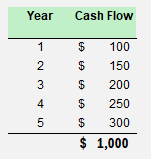
So you’ll receive $1000 cash in total. And let’s also assume you could get 5% each year by chucking your money in the bank3. The discounted cashflows would look like this:
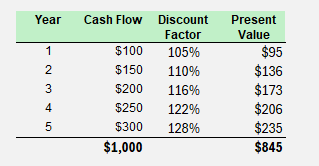
So that $1000 you’ll get back $1000 over the 5 year lifespan is effectively worth as much as having $845 today. If there were 100 shares available in this business opportunity, a fair price for them might be around $8.45 per share. It obviously gets exponentially more complex with a business like Games Workshop – but that’s the basic principle.
Now let’s imagine that instead of cash flows increasing by $50 every year, the growth will be lower, and it’s “only” increasing by $25 every year. What would that look like?
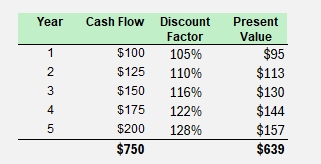
So now the value of the future cashflows has reduced to $639 and those 100 shares might be worth more like $6.39 each instead of $8.45. They have lost $1.06 of their value, but that’s very different from saying it’s a bad or loss-making investment. Quite the contrary: it’s continuing to return positive cash flows every year, and not only that, they are still increasing year on year; just increasing less rapidly compared to the first scenario. And that’s essentially what has happened with GW: the markets still believe they will continue to be profitable, and indeed to grow their profitability, just not as aggressively as they thought before. Hence the dip in the share price.

See that? “Potential for slowing growth”. Nobody is talking about GW moving into reverse gear or going broke. Well some gobshites on YouTube might be, but nobody who knows their arse from their elbow is saying that.
Nice, you explained that without talking about ratios once
Erm… can I quickly run through the P/E Ratio? In layman’s terms this shows a company’s share price as a multiple of how much money it’s currently making. If you think a company is going to the moon and about to start making a ton of money, you might value that share at a really high multiple of its current earnings, because you know the good news is right around the corner. Tech stocks are the classic example: they promise explosive returns after they’ve cracked their industry, so you’ll often see them trading at high multiples.
On the other hand if you think a business is about to hit the skids, even if it’s making good money right now you would put their value at rock-bottom: in other words, they’d have a low P/E Ratio.
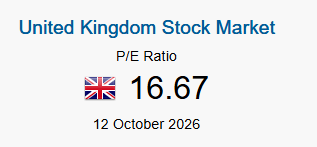
So the upshot is that a high P/E Ratio indicates strong confidence in growth ahead, whereas a low P/E ratio indicates that you think the business is stable or maybe even in decline. At time of writing, the average PE ratio for the UK’s FTSE 100 index is 16.67:
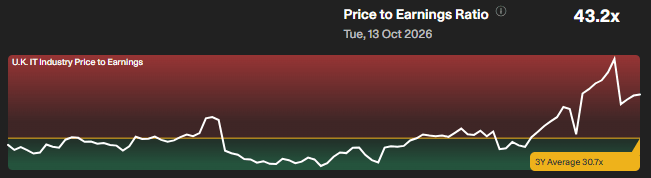
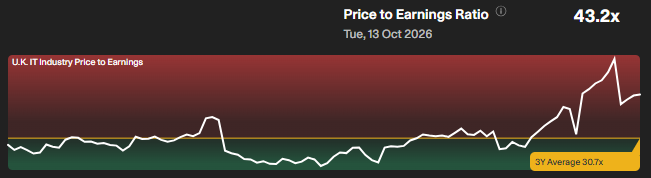
Tech stocks in the UK have an average PE Ratio of 43.2 today, and a 3-year average of 30.7:
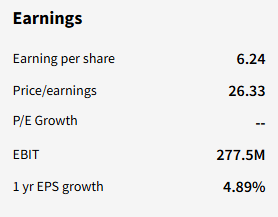
At time of writing, GW’s PE Ratio is 26.33. So while it’s no longer priced like a tech stock, it’s still well above average for big companies in the UK:
“Slowing growth” is still growth nonetheless, and even with their reduced share price, that’s how the markets are pricing Games Workshop: as a growth stock.
So why is growth slowing?
Plenty has been said about that already, and my main aim today was to show you what that drop in share price means (and what it doesn’t) rather than to add another voice to the cacophony of what they’re doing wrong. The FT article (linked below) gives an excellent analysis and it’s a highly recommended read – one thing that really stands out is how GW have taken a sugar hit from opening trade accounts in some really weird spaces, but if that stuff doesn’t sell through, it’s not exactly going to drive repeat sales:
“Thanks to Warhammer’s booming popularity in the past few years, the initiative helped expand the market from specialist gaming and hobby stores to post offices, tattoo parlours, leisure sites, bookshops and newsagents. […] But as soon as sales plateau, independent retailers are left with excess inventory and the growth flywheel goes into reverse. Falling revenue per trade account could be the first sign of that happening.”
Source
From a hobbyist perspective, I don’t play 40K so I’ll let the 40K guys be the judge of how exciting or otherwise they found the Armageddon box; I was never the target audience for that. I do think there’s some evidence that we are finally approaching the point of capping out on price increases though.
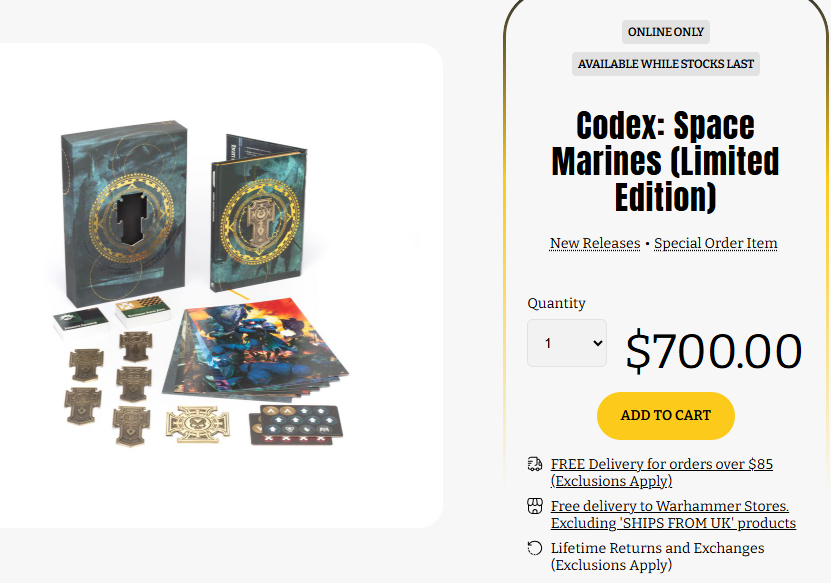
For several years I’ve been wondering who the hell actually buys this stuff; and yet, buy it people did. Sales have kept rampaging forward long past the point where I personally tapped out, and that shows that there’s still a large audience who love these minis and will pay astronomical prices for them. But trees don’t grow to the sky, and the notorious $700 Space Marine Codex is still available for sale on GW’s Australian webstore. If a limited edition Space Marines product isn’t selling out, you might have finally capped out on how far you can push people before they break.
So fundamentally GW’s share price is a constant wrestling match between reasons their business will grow above expectations, and reasons it might slow down. On the one hand:
- There’s a significant increase in manufacturing capacity due to come online soon (they’re physically capped out right now);
- Licensing opportunities, mainly from videogames;
- Expanding in growth markets such as SE Asia;
- And a potential burst into the mainstream from Amazon exposure.
And on the flipside:
- Manufacturing globally is obviously facing cost pressures;
- Cost of living / signs that infinite-price shafting may have identified its ceiling;
- 3D printing is only getting easier.
My goal today is not trying to predict which way the share price will go next, but to explain what is already happening for people who aren’t from a finance background. And the market’s verdict is that GW will continue to grow at a fairly rapid clip: if you think that’s over- or under-shooting their trajectory, then that’s up to you.
Further Reading
Here’s the original article from The Times that caused such a stir:
There’s also an excellent article here from the Financial Times which I would consider essential reading:
So there’s my thoughts on the whole thing, and hopefully it’s helped a few people understand what a declining share price actually means. I am pretty well-positioned to talk about this stuff since I work in finance as well as being highly invested in the hobby, so keep an eye out for more coverage on the business side of GW in future. I’ll still mainly be moaning about Orruks hitting on 4s though.
Have a good weekend, nerds. Catch you on the other side.

If you’d like to help us continue our work, we’d love to have your support. All Patreon Tiers include Discord access, exclusive articles and regular contests. Our Tiers are priced to be within everyone’s reach, so please click here to join us today!